


"My recovery score went from averaging 50s to averaging 70s after 3 weeks. The only variable I changed was AYO in the morning."
Most sleep problems aren't sleep problems.They're timing problems.

 120,000+ customers
 60-day money-back guarantee
 Free international shipping

Say Hello to Quality Sleep

AYO Wearable Can Boost
Your Winter Productivity

Best Light Therapy Product 2021

AYO Is My Secret Weapon
When The Days Get Shorter

A Session Of Blue Light Will Help
Correct The Body's Circadian Rhythm.

It’s Like A Wearable And Non-Addicting
Version Of Caffeine, Without The Crash

With AYO, I Fall Asleep And
Stay Asleep Almost Instantly.
Say Hello to Quality Sleep
AYO Wearable Can Boost
Your Winter Productivity
Best Light Therapy Product 2021
AYO Is My Secret Weapon
When The Days Get Shorter
A Session Of Blue Light Will Help
Correct The Body's Circadian Rhythm.
It’s Like A Wearable And Non-Addicting
Version Of Caffeine, Without The Crash
With AYO, I Fall Asleep And
Stay Asleep Almost Instantly.
Recommended By Sleep Physicians
Trusted by the doctors who treat sleep problems for a living.
“I encourage many of my clients to use blue light to boost their sleep health and their circadian rhythms, and the AYO device is the model I use myself”

AYO is a smart, well-designed tool for supporting healthy circadian rhythms. I appreciate the thoughtful design and often recommend it to my clients. AYO's genuine commitment to helping people improve their sleep and mood truly stands out.”

"AYO applies decades of circadian rhythm research in a form patients can easily use—whether they’re at home, at work, or traveling across time zones."

Recognize yourself?
You sleep 7 or 8 hours but still wake up tired
Sleep problems don't always look like insomnia. They often look like this:
You sleep 7 or 8 hours but still wake up tired.
You wake up between 2am and 4am and can't fall back asleep easily.
You feel exhausted by mid-afternoon, even on a quiet day.
You rely on melatonin, magnesium, or other sleep aids and still don't feel fully rested.
You sleep enough on paper, but you never feel restored.
Your sleep timing feels off, you can't quite settle at night, can't quite wake up in the morning.

If any of these sound like you, you're not alone, and you're probably not broken. What you may be experiencing is something most sleep advice never addresses: a circadian rhythm that has lost its timing.


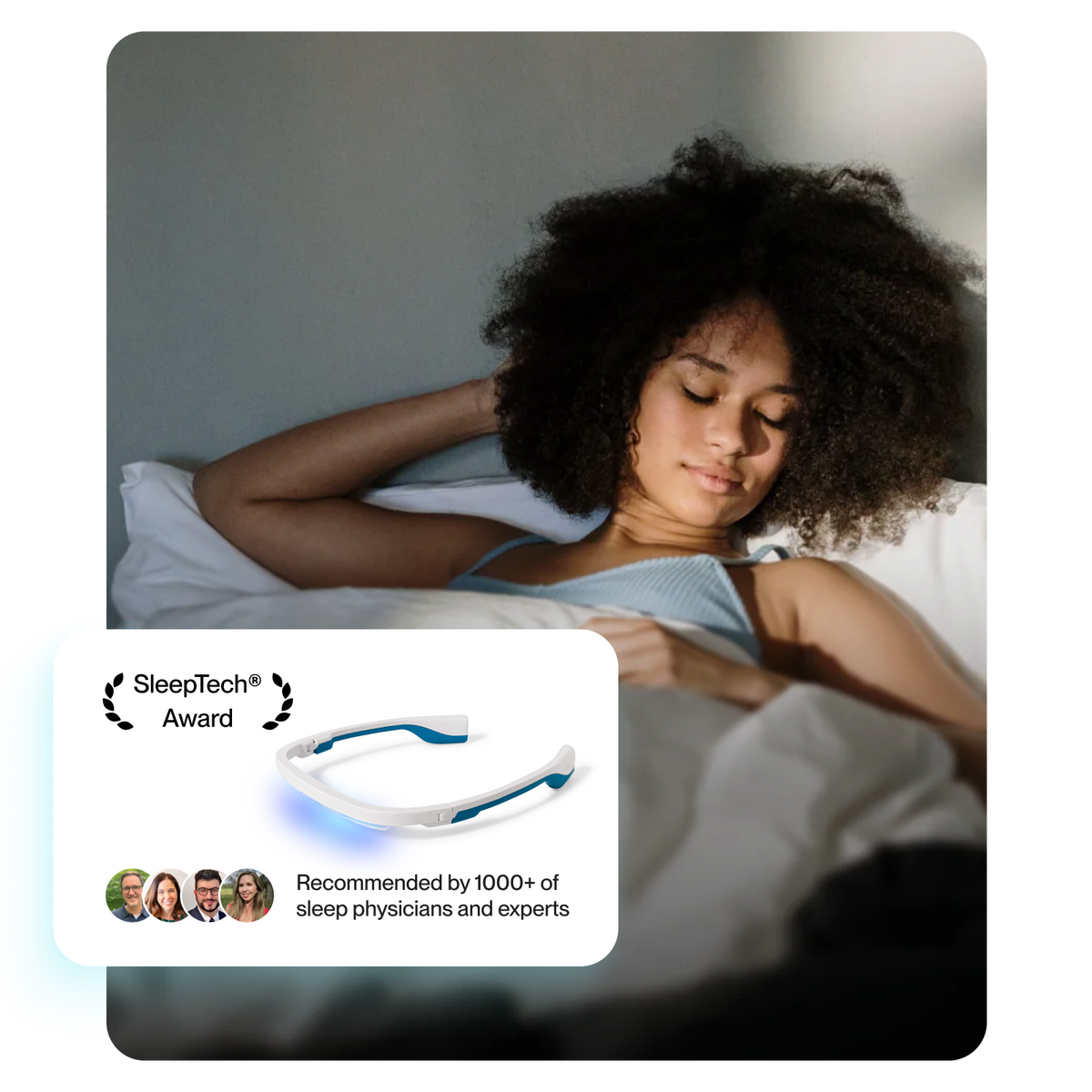
Recommended by 1000+ sleep physicians and experts
The Science
Most sleep problems start before bedtime.
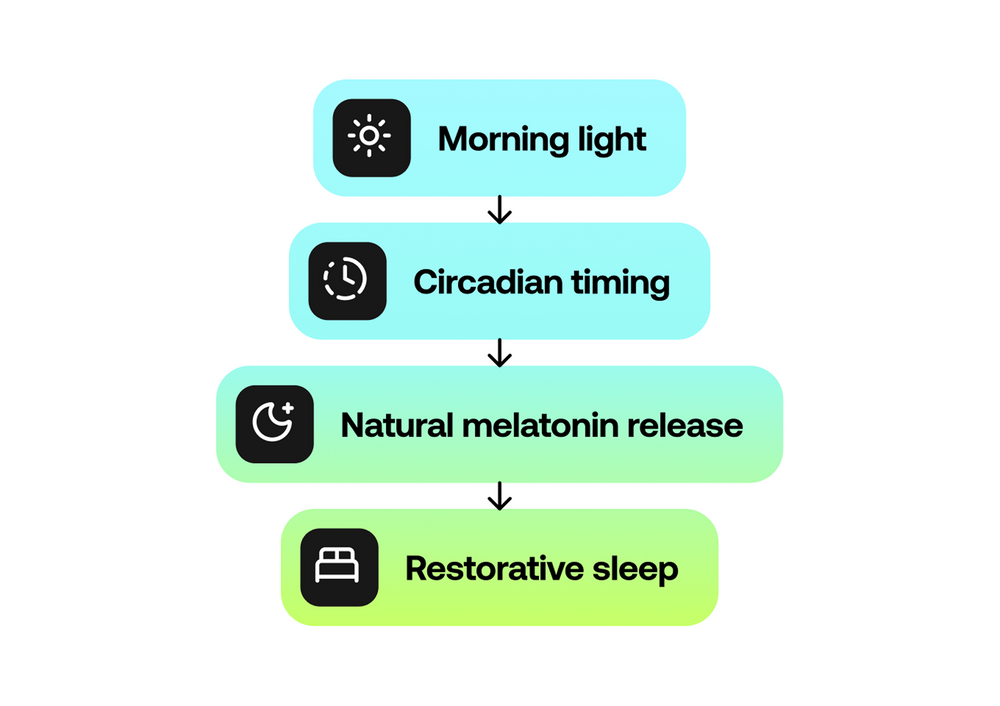
Your body has an internal clock. Doctors and researchers call it the circadian rhythm. It runs on a roughly 24-hour cycle, and it has one main job: figure out what time of day it is, so it knows when to release the hormones that make you alert in the morning and the hormones that make you sleepy at night
This clock is set by one primary signal. Light.
Specifically, bright light reaching your eyes in the first hour or two after you wake up. That signal tells your body, "the day has started." From that moment, your body begins a countdown. Roughly 14 to 16 hours later, it releases melatonin, your natural sleep hormone, and tells you it's time to sleep.
When this signal is weak — when your mornings are spent indoors under lighting that delivers a fraction of what your eyes actually need (typically 100–500 lux indoors, versus 10,000 or more outside) — the countdown never starts properly. Your body spends the day uncertain whether it's morning, afternoon, or still the middle of the night. And when bedtime comes, the timing your body needs to release melatonin smoothly isn't there. So, you lie awake. Or you fall asleep but wake at 3am. Or you sleep through the night but never feel rested.
This isn't a failure of willpower or sleep hygiene. It's a timing problem.
How much light does your body actually need?
Indoor lighting
100–500 lux
Sunlight
~30,000+ lux
The Solution
The fix starts in the morning.
AYO is a pair of light therapy glasses you wear for 20 minutes in the morning, within the first hour of waking. They deliver a precise, calibrated dose of 470nm blue light - the exact wavelength your circadian clock receptors are tuned to recognize as "morning."
That's the entire intervention. Twenty minutes. Worn while you make coffee, scroll your phone, get ready for the day.
Used consistently, AYO helps your body do what it's designed to do naturally: anchor the morning signal, trigger the right hormones at the right time, and ensure melatonin arrives on schedule at night, so sleep is there when you need it.
How AYO supports sleep:
 Anchors your body's natural sleep-wake timing to a consistent 24-hour cycle
Promotes earlier, more reliable melatonin onset at night
Reduces daytime fatigue by triggering the cortisol awakening response at waking
Supports natural melatonin timing without supplements or sedatives
Anchors your body's natural sleep-wake timing to a consistent 24-hour cycle
Promotes earlier, more reliable melatonin onset at night
Reduces daytime fatigue by triggering the cortisol awakening response at waking
Supports natural melatonin timing without supplements or sedatives
AYO doesn't replace sleep aids, supplements, or sleep hygiene practices. It works on a different layer entirely - the timing layer that most sleep advice never addresses.
Common Question
"Wait — isn't blue light bad for sleep?"
This is arguably the most common question we hear, and the answer matters.
You've probably read that blue and bright light from phones and screens can disrupt sleep. That may be true, at night. The reason is that strong light signal at night tells your body's clock "it's daytime," which suppresses melatonin and delays sleep onset.
But the same signal that disrupts sleep at night is exactly what your body needs in the morning.
Strong morning blue light is the signal your circadian clock evolved to recognize. It's how your body knows the day has started, and how it knows when to release melatonin 14 to 16 hours later.
Timing is what matters.
AYO is calibrated to deliver morning light at the specific wavelength (470 nanometres) and intensity your circadian receptors respond to, during the window when it helps. It is not the same as the scattered blue light from a phone screen at 11pm. Different wavelength. Different intensity. Different time of day. Different effect.
There's a specific group of people for whom evening light therapy is actually helpful, not harmful. If you find yourself falling asleep at 8 or 9pm and waking up at 3 or 4am, your circadian rhythm may be running too early — a pattern called advanced sleep phase, common in older adults and natural early birds.
For this group, a short AYO session in the evening can help delay melatonin onset, shifting your sleep window to a more conventional hour, so you fall asleep later and wake up closer to 7am instead of in the middle of the night
This is the opposite of the typical pattern, and it needs the opposite intervention. The companion app helps you identify which pattern matches you and when to use AYO accordingly.
What To Expect
What the first 30 days usually look like.
Circadian rhythm change is gradual. It doesn't happen on night one. Here's the timeline most people report:
Week 1
Mornings start to feel different. The thick, foggy feeling between waking and your second coffee begins to thin. You don't pop out of bed singing but you stop feeling like you got hit by a truck.
Week 2
The night side begins to shift. People who used to wake at 3am report sleeping through. People who couldn't fall asleep until midnight start feeling tired earlier. Some experience both.
Week 3
The improvements start to compound. Waking up at 3am becomes the exception rather than the pattern. Falling asleep feels less effortful, your body starts moving toward sleep before you've consciously decided to wind down. You notice you're reaching for the afternoon coffee less automatically.
Week 4
The protocol disappears into your routine. You're no longer tracking whether it's working - you're just waking up. Sleep timing has stabilized, the mid-afternoon energy dip has flattened, and the heaviness that used to define your mornings is gone. What started as an intervention has become your baseline.
"Integrating AYO into my patients' morning routines has become a standard part of my sleep reset protocol. When timed correctly, I find patients fall asleep more easily, experience deeper sleep, and report improved mood and alertness during the day."
Kate Blyth · Sleep Therapist · Founder of Intuitive Sleep
Real users. Real wearable data.
Rated 4.7 stars on Trustpilot
The Research
The science behind the device.
AYO's underlying mechanism is supported by decades of peer-reviewed circadian research from the world's leading sleep and chronobiology labs.
CZEISLER · HARVARD
"Bright light resets the human circadian pacemaker independent of sleep-wake timing."
Science, 1986 · the seminal phase-shifting paper
HUBERMAN · STANFORD
"Get sunlight in your eyes first thing in the morning. If you can't get outside, use artificial lights."
Huberman Lab · morning sunlight protocolt
RUSSELL FOSTER · UNIVERSITY OF OXFORD
"We should start the day with taking a photon shower."
4th VELUX Daylight Symposium · 2011
Researchers at the U.S. Naval Health Research Center evaluated AYO as a wearable circadian countermeasure for Navy submariners operating under rotating shifts, prolonged darkness, and high operational demands. Published in SLEEP Advances (Oxford University Press), the peer-reviewed study found that individually timed light intervention via AYO improved sleep quality, reduced fatigue, and supported circadian adaptation to demanding schedules, highlighting its potential to support readiness and performance in challenging environments. Validated in Extreme Operational Environments: U.S. Navy Research on Sleep, Fatigue, and Performance
Try it
Try AYO for 60 days. If your sleep isn't different, send them back.


See how it works

Better natural sleep in 7 days

Feel energized in 20 minutes

Beat the winter blues

Embrace wellness that lasts a lifetime
AYO+ (White-Blue)
Complete Package with App Access
$299
$499
Includes
1 unit
— perfect for personal use
Premium AYO+ Light Therapy Glasses
Protective Travel Case
1-Year International Warranty
AYO App Lifetime Access
USB-C Charging Cable
Free Worldwide Shipping
Blue & Red Light Therapy
FSA/HSA Eligible

White / Blue
Classic Edition
$299
1

Carbon Black
Exclusive Edition
$319
0

2-year Complete Protection
+$49
Added: drop, spills, other accidental damage, theft
Accidental damage
Theft
Malfunctions
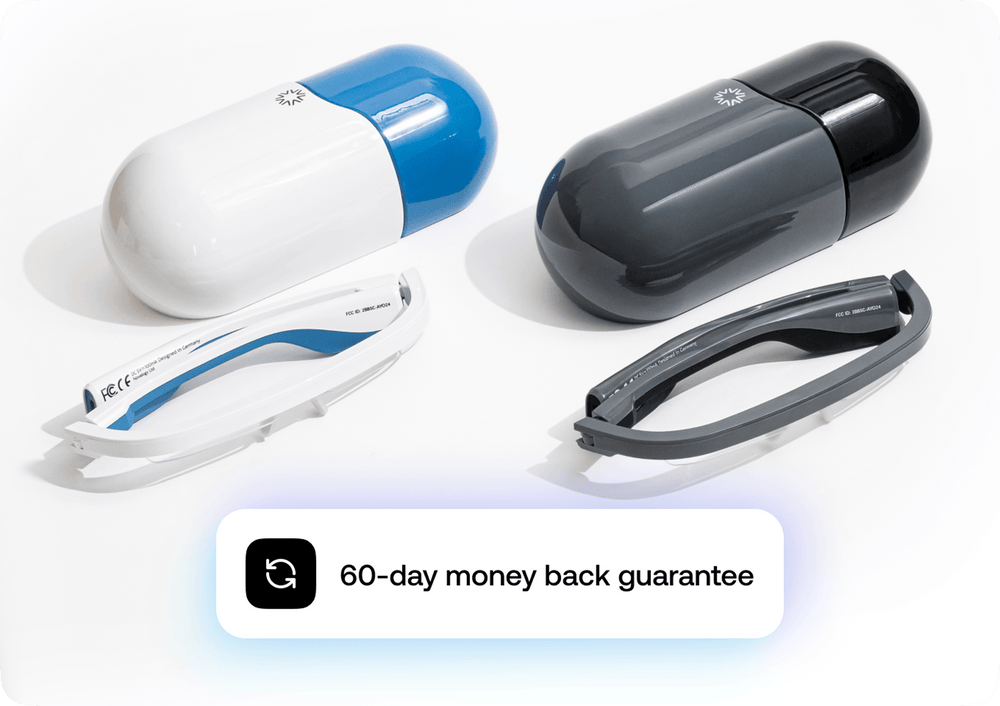
60-Day Money-Back Guarantee

 Secure SSL Checkout


Frequently asked questions
Most people notice mornings feeling cleaner within the first week — less grogginess, more natural alertness. Sleep changes typically follow in week two. The full effect compounds over four to six weeks of consistent daily use.
For the first month, yes - daily use is what builds the circadian shift. After that, most people settle into five or six mornings a week and find that's enough to hold the rhythm in place, especially if they get natural morning light during the rest of the days.
AYO still works for non-standard schedules. You can wear it within the first hour of waking, whenever your personal "morning" is or before an evening or a night shift. You can also contact us directly for personal guidance once your AYO arrives.
AYO is considered safe for the eyes in accordance to the international standard IEC 62471 governing the photobiological safety of light emitting devices. It’s in the exempt group for both its blue and red lights. On the contrary, red light of the same wavelength which AYO can emit as well (670 nm) has been shown to aid ocular health.
AYO works on a different mechanism entirely (timing, not sedation), so it doesn't interfere with sleep aids or supplements. You can continue whatever your current protocol is. Many people find they gradually rely less on supplements over time as their rhythm stabilizes, but any changes to prescription medication are a conversation for you and your physician.
AYO is a consumer wellness device, not a medical treatment or diagnostic tool. It works by delivering calibrated light to support your body's natural circadian timing - the same mechanism your body uses every day in response to sunlight. It is not designed to treat, cure, or diagnose sleep disorders. If you are currently being treated for a sleep disorder or taking prescription sleep medication, speak with your physician before making changes to your protocol.
Yes. AYO is designed to be used with the most common prescription glasses’ frames. It can be also used with prescription and tinted eye lenses.