


Featured In


Works With


Works With
Used by Elite Performers


The Problem Your Wearable Won’t Solve
You've been tracking for years.
Your numbers haven't moved.
The wearable industry solved measurement. It has not solved the upstream cause of bad numbers: the misalignment between your body clock and your day. Caffeine masks it. Magnesium softens it. Nothing moves the master clock — except light, at the right intensity, at the right time, into your eyes.

Recovery stuck in the yellow zone
Your Whoop tells you it's a "pay attention" day. Again. Coffee, more water, magnesium — nothing changes the trend line.

HRV plateaued for months
You optimized hydration, training load, sleep window, alcohol intake. The 30-day average won't budge.

Deep sleep under target every night
Oura says you need 90 minutes. You're getting 41. Sleep aids help latency but not deep-sleep architecture.

Readiness rarely "optimal"
2 out of 7 days you're cleared to train hard. The other 5 are "take it easy" — and it never improves.
Proven Technology
Light is the main input strong enough to reset the circadian master clock.
Whoop, Oura, and Garmin measure your body's response to one root cause: your circadian clock. When it's misaligned by even 1–2 hours, your numbers tank, regardless of how much you sleep or train.
CZEISLER · HARVARD
"Bright light resets the human circadian pacemaker independent of sleep-wake timing."
Science, 1986 · the seminal phase-shifting paper
HUBERMAN · STANFORD
"Get sunlight in your eyes first thing in the morning. If you can't get outside, use artificial lights."
Huberman Lab · morning sunlight protocol
Russell Foster · University of Oxford
"We should start the day with taking a photon shower."
4th VELUX Daylight Symposium · 2011
Researchers at the U.S. Naval Health Research Center evaluated AYO as a wearable circadian countermeasure for Navy submariners operating under rotating shifts, prolonged darkness, and high operational demands. Published in SLEEP Advances (Oxford University Press), the peer-reviewed study found that individually timed light intervention via AYO improved sleep quality, reduced fatigue, and supported circadian adaptation to demanding schedules, highlighting its potential to support readiness and performance in challenging environments. Validated in Extreme Operational Environments: U.S. Navy Research on Sleep, Fatigue, and Performance
How AYO works
How AYO fixes timing.
20 minutes a day
20 minutes a day


Default: Blue light
In-app toggle on: Red light
Stack With What You Own
Your stack, leveled up.
AYO doesn't replace your tracker. It improves the upstream input your tracker measures.

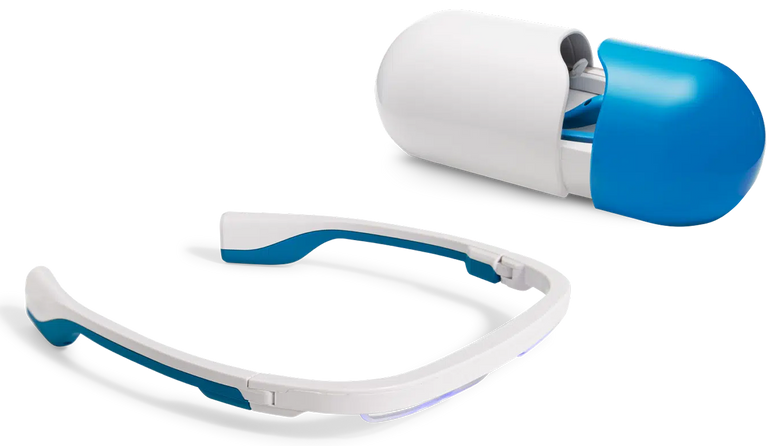
You already have
What AYO adds
Whoop
Improved Recovery (HRV) scores by anchoring your circadian phase before the strain begins. Run AYO before your morning Whoop check-in.
Oura Ring
Better Readiness. Oura is correlated against polysomnography at r²=0.79 for sleep staging — AYO upstream-improves the sleep the ring measures.
Garmin · Apple Watch
Better sleep scores and recovery readings. Wrist wearables track the outputs of your circadian rhythm. AYO is what sets the rhythm those outputs reflect.
Eight Sleep Pod
Thermoregulation handles temperature. AYO handles light. Together they cover both master sleep inputs.
Real users. Real wearable data.

Rated 4.7 stars on Trustpilot
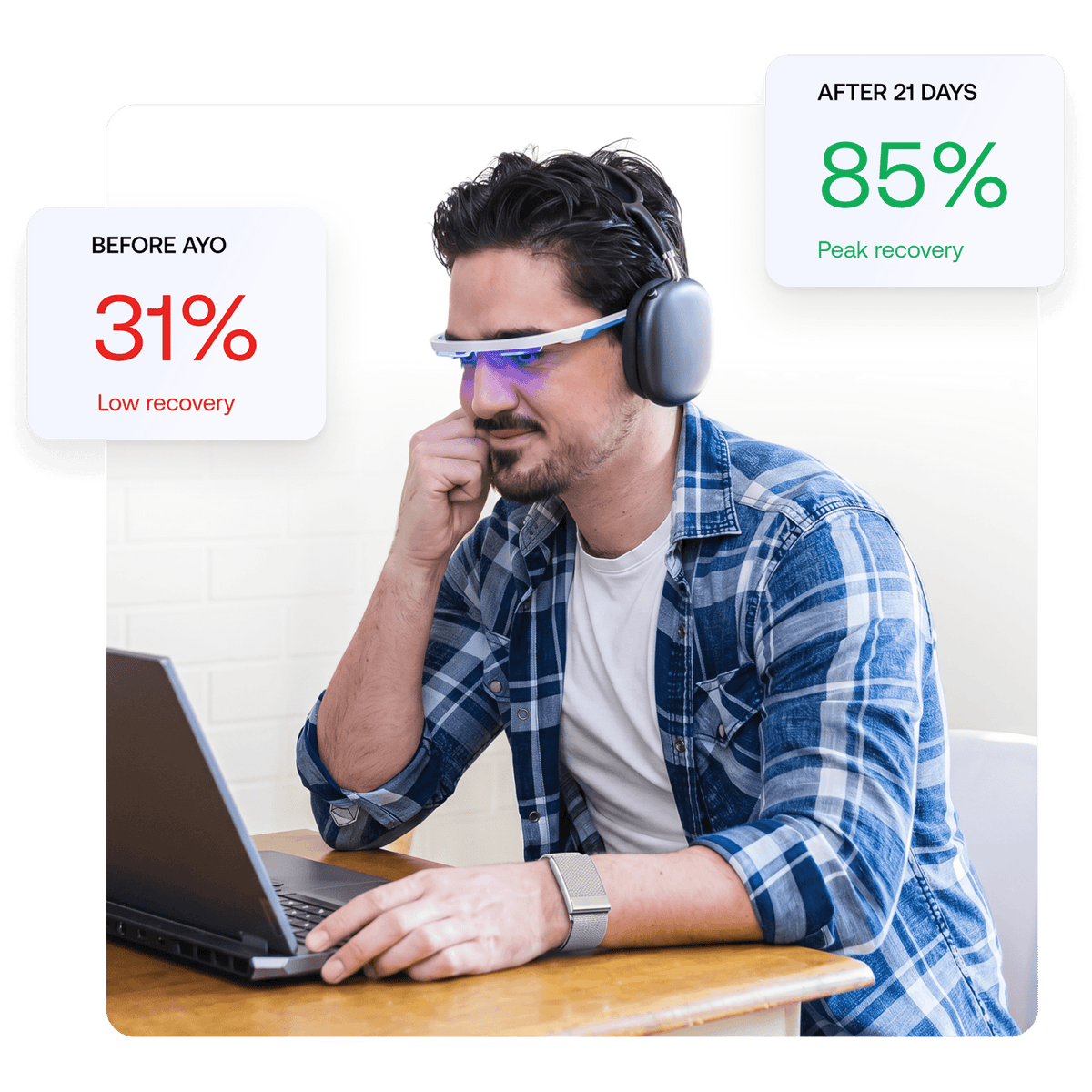
 RECOVERY: 50s → 70s · 3 weeks
"My recovery score went from averaging 50s to averaging 70s after 3 weeks. The only variable I changed was AYO in the morning."
 SLEEP LATENCY: 38m → 12m
After each use I feel a burst of energy and my sleep quality has greatly improved (I’ve been tracking my sleep with Oura for a while). I used it also for my latest trip overseas and it almost fully eliminated my jet lag.
 HRV: +18ms · 30 days
This is a good piece of gear, couple weeks in sleep quality has increased (SWS 30% improved, REM 40% improved. I monitor sleep with a WHOOP). Daily energy is fantastic and overall mood is greatly improved. I would highly recommend this product.
Pick Your AYO
Better Sleep. More Energy. Sharper Days.


See how it works

Better natural sleep in 7 days

Feel energized in 20 minutes

Beat the winter blues

Embrace wellness that lasts a lifetime
AYO+ (White-Blue)
Complete Package with App Access
$299
$499
Includes
1 unit
— perfect for personal use
Premium AYO+ Light Therapy Glasses
Protective Travel Case
1-Year International Warranty
AYO App Lifetime Access
USB-C Charging Cable
Free Worldwide Shipping
Blue & Red Light Therapy
FSA/HSA Eligible

White / Blue
Classic Edition
$299
1

Carbon Black
Exclusive Edition
$319
0

2-year Complete Protection
+$49
Added: drop, spills, other accidental damage, theft
Accidental damage
Theft
Malfunctions
60-Day Money-Back Guarantee

 Secure SSL Checkout
AYO for Top Performers
Used by those who set the standard, not follow it


Frequently asked questions
Yes, by anchoring your circadian phase. The primary mechanism is melanopsin-driven SCN signaling, which regulates autonomic tone - including vagal activity,the key driver of HRV. The phase-resetting foundation is well-established and thedownstream HRV effect varies by individual and baseline circadian alignment.Most consistent users see measurable shift within 14–21 days.
Yes. Morning or afternoon sessions work well. You can wear AYO during a warm-up, steady-state cardio, or strength work without affecting light delivery. Avoidpairing it with evening training, as both late exercise and blue light delaycircadian phase, compounding the problem. Stack them in the right direction:morning light, morning movement.
That said, suitability depends on the type of exercise. High-contact sports,activities requiring full peripheral vision, or anything where a wearable couldbecome a hazard aren't ideal. Always prioritize safety and use your judgment - ifit compromises your movement or focus, take it off.
Not yet via direct API. AYO currently connects through Apple Health / Google Health Connect. If your Oura or Whoop already syncs there, your sleep data will flow through. A native integration is on the roadmap. In the meantime, most performers and biohackers run AYO alongside their wearable and correlate the data manually, which actually gives you a useful before/after lens on circadian alignment.
If you can get 10 minutes of low-angle sun outside every morning, do it. If youlive anywhere north of latitude 40° in winter, have early call times, travel, or a5am training, AYO is the indoor replacement Huberman himself acknowledges isneeded in those conditions.
Yes. AYO is TÜV Rheinland certified for photobiological safety, UV and IR free,and compliant with FCC and CE standards. The light is blue-turquoise, outside ofultraviolet or blue-violet type of lights.
The underlying mechanism is the same one your eyes use every morning to readnatural daylight. Used as directed (correct timing, recommended session length),it's designed for daily use by definition. Circadian entrainment is a dailybiological process; the tool matches the rhythm it's supporting.
AYO is considered safe for the eyes in accordance to the international standard IEC 62471 governing the photobiological safety of light emitting devices. It’s in theexempt group for both its blue and red lights. On the contrary, red light of thesame wavelength which AYO uses (670 nm) has been shown to aid ocular health.